
Lafayette Previous-Resident Source Eras
The backward trail for one Lafayette Parish address changes with the date. Current parcel and tax systems can supply the starting identifiers. The Clerk's land index carries recorded transfers and related instruments. City directories and census schedules add the household layer, while maps and newspapers help when an address changed. No source is a full roster of previous residents. Build a dated chain and mark whether each name came from ownership, assessment, occupancy, or a notice.
| Source | Years covered | Where held | What it can show |
|---|---|---|---|
| Clerk land index | Several land categories from 1935; conveyance category from 1966 | Lafayette Parish Clerk eSearch and office | Transfer parties, instrument date, legal description, mortgage or cancellation |
| Assessor and tax roll | Current roll; linked historic tax years when available | Assessor/Beacon and Sheriff tax portal | Parcel, situs, displayed owner, taxpayer, value, exemption, tax year |
| City directories | Named years 1939-1959; LPL says 1946-present | LPL, UL, and institutional microfilm | Dated household, address, telephone, and other printed fields |
| Federal census | Released schedules under the 72-year rule | Libraries, archives, and databases | Household, ages, relationships, and place on census date |
| Sanborn map | 1906, six sheets | Library of Congress | Historic building, block, use, and street context |
| Newspaper and obituary files | Obituary index 1882-2022; newspaper runs vary | UL Lafayette and LPL | Addresses, relatives, legal notices, events, and death clues |
Choose the first source by era. For a recent transfer, start with the parcel and latest deed. For a mid-century household, compare directories with deeds and a released census. For an address before the directory runs, use the legal description, older land books, newspapers, church files, and the 1906 map where its sheets cover the block.
Lafayette Parish Deed Chain Backward
The Lafayette Parish Clerk of Court records conveyances, mortgages, cancellations, plats, and related instruments. The Assessor identifies and values the parcel, but it is not the recorder. Begin with the current parcel ID and legal description from Beacon or LCG GIS. Then locate the latest recorded conveyance. A legal description is the land wording in the instrument, often tied to a subdivision, lot, block, or plat. It remains useful when a street number changes.
- Copy the parcel ID, situs address, displayed owner, and full legal description.
- Search the Clerk's conveyance index for the current owner's purchase instrument.
- Open the instrument and record its parties, date, act or entry number, and prior reference.
- Use the seller as the next search name, finding when that party acquired the same land.
- Repeat with the matching description, then move to written indexes, deed books, or the plat cabinet when online coverage ends.
- Grantor and grantee
- The grantor transfers an interest; the grantee receives it. Louisiana index labels may also use vendor and vendee.
- Chain of title
- The linked sequence of recorded transfers for the same land.
- Legal description
- The formal parcel description used in an instrument, more stable than a mailing line.
- Act or entry number
- The Clerk's identifier for a recorded instrument and a key citation for a copy request.
A name in the index is not the final legal conclusion. Read the image and follow prior-act, book/page, and plat references. The eSearch terms warn that an item may not yet be fully indexed or released. A current-through date describes search status, not a guarantee that each image is complete.
Lafayette Previous Residents in eSearch
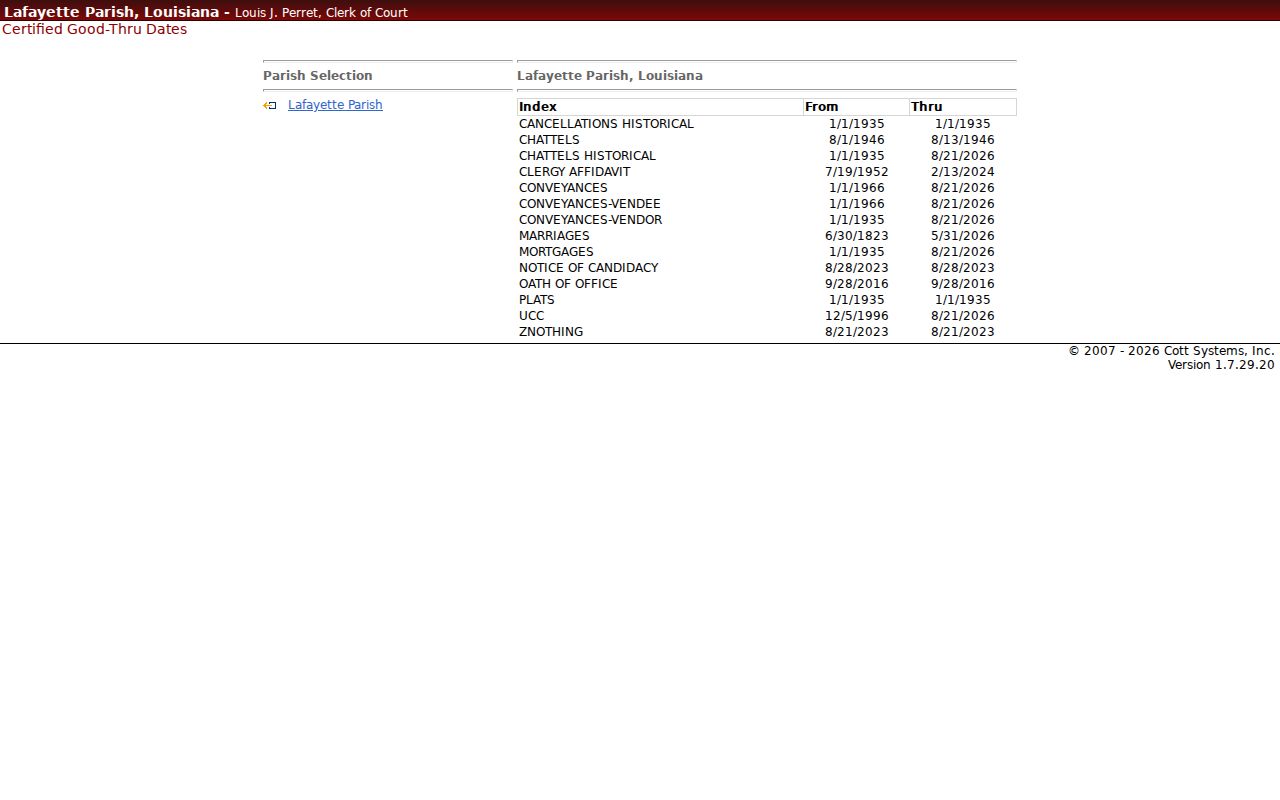
The Lafayette Parish Clerk certified-dates table is the best public checkpoint before a long deed search. Research found conveyance-vendor and several land categories beginning January 1, 1935, while the conveyance category begins January 1, 1966. Mortgage and cancellation categories also reach to 1935. Online images begin in January 1935, but older written indexes and local books may extend the trail. Access to the land system uses an account or subscription, and copies or images can carry charges.
If the index says “See Plat Filing Cabinet,” keep the file number and ask for that cabinet or image page. Do not assume the plat is missing. In-person and written Clerk requests are the fallback when a login fails, an image is absent, or the chain predates online coverage. The Clerk also describes preservation, scanning, rebinding, microfilm-to-image work, and media transfer to the State Archives, though no exact imaging cutover was documented.
Separate Lafayette Address Identities
A Lafayette Parish property can carry four address identities: the USPS mailing line, the LCG address point, the Assessor's situs address, and the Clerk's legal description. Situs means the physical location used on the parcel record. The Assessor's mailing-address form separates the property address from a new mailing address, including care-of, street or post-office box, city, state, and ZIP+4. A tax bill sent elsewhere does not prove the resident lived away from the parcel.
Record all four identities when they differ. Also save the assessment year, exemption flag, tax year, and any subdivision or lot reference. An owner name answers whom the assessment roll associates with the parcel. A taxpayer field says who receives or pays a bill. Neither is automatically a complete list of past residents. Confirm recorded ownership with the Clerk and occupancy with dated household sources.
Insider tip. Follow the legal description through old deeds when a house number or mailing ZIP changes.
Lafayette Past Residents Between Censuses
Deeds trace recorded owners, not every person who lived at an address. Lafayette city directories supply snapshots between census years. The institutional microfilm list names 1939, 1941, 1946, 1949, 1952, 1955, and 1957 through 1959; Lafayette Public Library reports city directories from 1946 to the present. The reviewed sources did not prove exact reverse or criss-cross coverage. Check each volume for a street-order section before assuming an address search is possible.
Use this process flow: directory name and address → nearest released census household → next directory edition → newspaper or obituary → deed and tax cross-check. Copy the directory's abbreviation key and page. In a census, note the household on the census date, the enumeration geography, spelling, ages, and relationships. An enumeration district is the area assigned to a census taker. Boundary changes can put the same place in a different district or parish-era context.
The collection details and reading method appear on the Lafayette Parish city directories page. Here, each directory line serves one purpose: testing who occupied this one address at a certain time. A missing year or missing name should remain a gap until another dated source fills it.
Map Lafayette Past Residents' Address
The 1906 Lafayette Sanborn set has six sheets. It can show a building footprint, block, street, use, and nearby establishments from that date. It cannot identify legal ownership by itself. LCG historic-preservation guidance warns that Sanborn square numbers may change and not every neighborhood appears. Start with bounding streets and the latest known map sheet, then work backward. Preserve the sheet number, date, and block context in the research note.
Compare the historic footprint with current LCG GIS only after checking street alignment and parcel shape. A building can disappear while the lot survives; several lots can be combined; or one old tract can be split. Current GIS adds parcel context and address points, while the recorded deed supplies the legal chain. The map is most useful as a bridge between place and time.
Lafayette Previous Residents in Print
UL Lafayette's Daily Advertiser Obituary Index spans 1882 through 2022. Lafayette Public Library's digital newspaper collection includes the Lafayette Gazette from 1893 through 1908 and Daily Advertiser and Sunday Advertiser runs from 1974 through 1978. Search by people, places, and events. Try initials, married names, accents, nearby municipality names, church names, and both Lafayette and Vermillionville where the date calls for it.
An obituary may identify family, cemetery, former residence, or occupation. Property notices and social items may tie a name to an address. Each remains a newspaper claim. Save the paper title, date, page, and image, then test the fact against a directory, church register, cemetery record, probate file, or deed. The Lafayette Genealogical Society can suggest local materials, but it is not a complete resident index.
Lafayette Household Trail Endpoints
Church and cemetery records can close a household trail after a person leaves the address. Diocese of Lafayette policy does not offer a broad name-only search for sacramental records before 1993. A useful request needs the parish, sacrament, and date. Start with a directory, obituary, family note, or newspaper reference that points to the right church and time.
The Louisiana Cemetery Board provides a contact map, not a burial index. Individual cemeteries keep their own registers and plot records. Once an obituary or church source identifies a likely cemetery, ask that custodian about the exact person and date. Probate records may then connect heirs or estate activity, but should be searched through the proper court index and read as case records, not as proof of residence by themselves.
Lafayette Address History Boundaries
Old place names and parish borders matter. Lafayette was incorporated as Vermillionville in 1836 and renamed in 1884. The parish formed from territory tied to St. Martin and once included land later associated with Vermilion and Acadia. A nineteenth-century record may be correct for its date even when the modern parish label differs. Check the event year against the boundary history before rejecting it.
The parish today is not one city. Broussard, Carencro, Lafayette, Scott, and Youngsville are cities; Duson is a town; Milton is unincorporated. A Lafayette mailing line may sit outside the legal city. Keep the municipality, parish, ZIP, and custodian distinct in every note. That prevents a city-court, tax, directory, or church search from being applied to the wrong jurisdiction.
Use Lafayette Previous-Resident Records Carefully
Previous-resident research is well suited to family history, estate questions, preservation work, and curiosity about a house. Public indexes can still contain mistakes, late filings, stale names, and protected fields. Address confidentiality, sealed or juvenile matters, closed vital certificates, and portal coverage limits can explain a missing result. A gap is not proof that nobody lived there.
Lawful use. Use Lafayette Parish address history for a legitimate personal purpose, and never use it to track, stalk, harass, or harm a living person.
Keep a source log with the custodian, collection, date span, page or instrument number, and access date. Label each name as owner, taxpayer, listed householder, census resident, or newspaper subject. That small discipline protects the difference between what the record says and what the researcher infers.